The rig is the foundation. Get this wrong and everything bolted to it flexes, rattles, or wobbles under braking. This guide covers what matters, what does not, and which cockpits we recommend at every price point in 2026.
Why the rig matters more than you think
A direct-drive wheelbase puts 5 to 32 Nm through the steering column. A desk clamp flexes. A cheap rig flexes less, but still enough to eat detail you paid good money for. The rig is the last link in the chain between the sim physics engine and your hands. If it is not rigid, you are filtering signal before it reaches you.
Upgrading from a desk clamp to a proper cockpit is the single biggest improvement most sim racers will make. It matters more than upgrading your wheelbase, more than upgrading your pedals, more than a new GPU. The rig is the platform everything else sits on.
Every rig we track, sorted by price. Colour indicates frame type.
Aluminium profile (15)
Steel tube (8)
Folding (3)
Full simulator (2)
Price versus weighted rubric score. The sweet spot is bottom-right: high score, low price.
Frame types explained
Aluminium profile (80/20)
T-slot aluminium extrusion, bolted together with brackets. Infinitely adjustable, rigid when assembled properly, and the community favourite for mid to high-end builds. The downside: assembly takes two to four hours, and the industrial aesthetic is not for everyone.
Steel tube
Welded or bolted steel frames with a more traditional cockpit look. Often come with integrated seats. Less adjustable than profile rigs, but faster to assemble and sometimes more compact. Rigidity varies wildly by brand and model.
Folding rigs
Designed to collapse flat when not in use. The right choice if you genuinely cannot leave a rig set up. The wrong choice if you are running a high-torque direct drive: they flex under load and the folding joints are the weak point.
Full simulators
Enclosed cockpits with integrated screens, sometimes motion platforms. The endgame for space-rich, budget-flexible buyers. Prices start around $2,000 and climb fast.
| Frame type | Count | Avg price | Avg score | Distribution |
| Aluminium profile | 15 | $708 | 4.0 | |
| Steel tube | 8 | $815 | 3.7 | |
| Folding | 3 | $286 | 3.4 | |
| Full simulator | 2 | $1425 | 3.6 | |
What to look for
- Rigidity under load. The single most important factor. A rig that flexes under braking or high FFB kills immersion. Aluminium profile rigs win here.
- Adjustability. Can you dial in your seating position precisely? Pedal angle, wheel height, screen distance. Profile rigs are infinitely adjustable; steel tube rigs are limited to pre-drilled holes.
- Wheelbase compatibility. Check the mounting pattern and the maximum torque rating. A rig rated for 10 Nm will flex under a 25 Nm base.
- Monitor support. Single, triple, or ultrawide? Some rigs include monitor mounts; others sell them separately. Factor this into the total cost.
- Footprint. Measure your space before buying. A full-size profile rig needs roughly 150 x 60 cm of floor space, plus room to get in and out.
- Assembly time. Profile rigs take 2-4 hours. Steel tube rigs take 30-90 minutes. Folding rigs are often ready in under 30 minutes.
Top-scoring rig at each price tier, based on weighted rubric scores from independent reviewer consensus.
Entry ($200-500)
8 rigs in this range

SimXPro X80 GT
Mid ($500-1,000)
14 rigs in this range

Sim-Lab P1-X Pro
High ($1,000-2,000)
5 rigs in this range
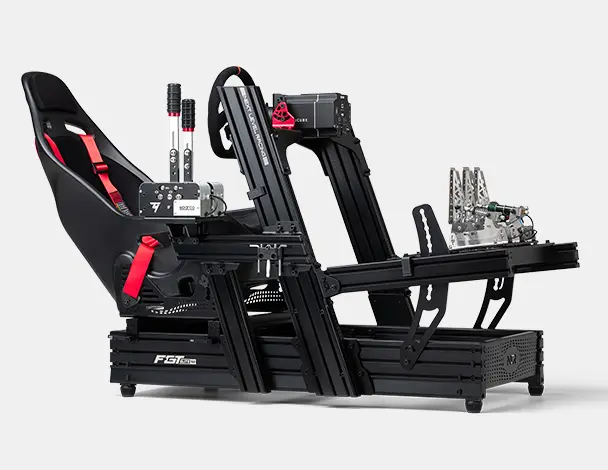
Next Level Racing F-GT Elite 160
Flagship ($2,000+)
1 rig in this range

Playseat Formula Intelligence
What to spend
Budget sets the floor for rigidity. Here is what each tier gets you:
- $200-500 (entry): Folding rigs and budget aluminium frames. Fine for belt-drive and entry direct-drive. Expect some flex under 10+ Nm loads.
- $500-1,000 (mid): The sweet spot. Solid aluminium profile rigs from Sim-Lab, Trak Racer, and Advanced SimRacing. Handles any direct-drive base without complaint.
- $1,000-2,000 (high): Flagship frames with thick extrusions, integrated cable management, and sometimes bundled seats. Buy once, keep for years.
- $2,000+ (flagship): Full simulators and motion-ready platforms. The endgame.
Common mistakes
- Buying a rig that cannot handle your wheelbase. A rig rated for 8 Nm belt-drive will flex and creak under a 20 Nm direct-drive. Check the torque rating before buying.
- Ignoring the seat. Many rigs ship without a seat. A good bucket seat costs $150-400 on top. Factor this into your total budget.
- Underestimating footprint. A full-size rig is a piece of furniture. Measure your space. Consider a folding rig if floor space is genuinely limited.
- Chasing the cheapest option. A $250 rig that flexes will frustrate you within months. Spend $500-600 on a mid-range profile rig and you will not need to upgrade for years.
How we score
Every rig is scored on seven axes by aggregating independent reviewer assessments. The axes are weighted: rigidity (1.5x), value (1.3x), adjustability (1.2x), comfort (1.0x), compatibility (1.0x), assembly (0.8x), footprint (0.7x). We do not accept products for review. All scoring is based on published reviews from independent creators.